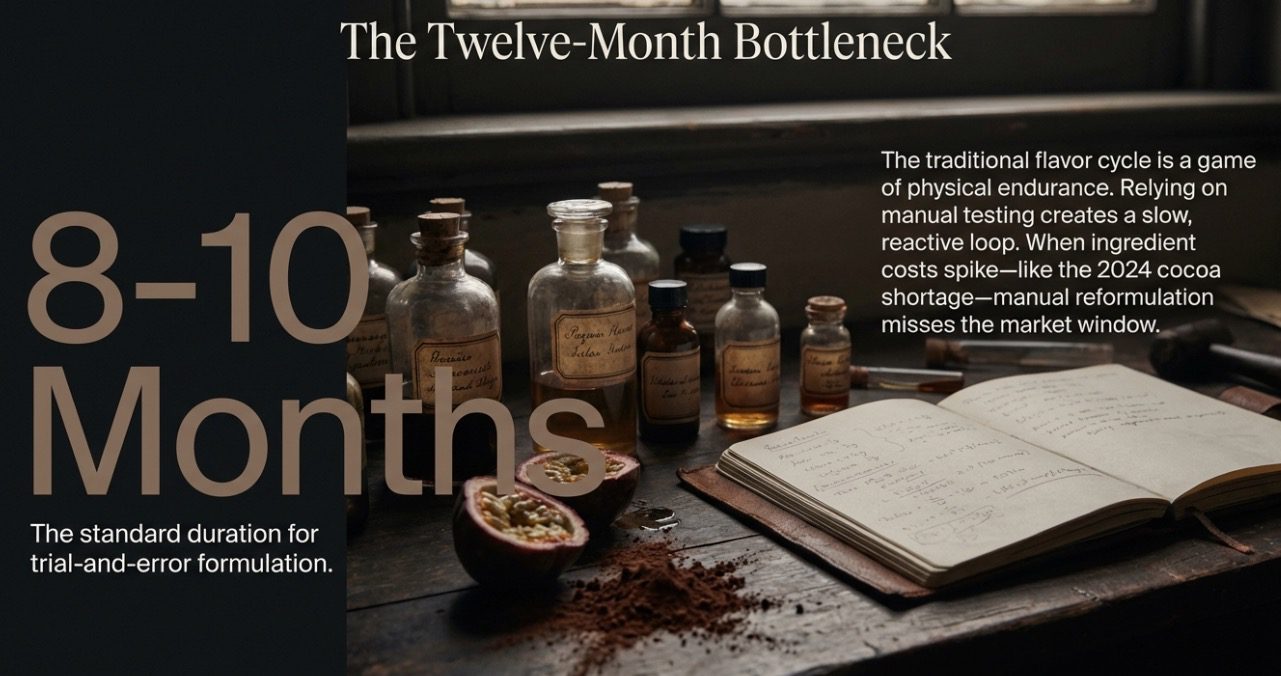
Artificial intelligence is fundamentally reshaping how beverage companies develop new flavors. Companies implementing AI-driven flavor development report 20-33% reductions in time-to-market, with significantly lower formulation failure rates through precise molecular analysis and consumer preference prediction. Traditional R&D processes requiring months of iterative testing can now screen thousands of ingredient combinations within days to identify optimal formulations. According to 2024 market projections, the global AI in food and beverages sector will grow from $10.8 billion to approximately $50.6-84.75 billion by 2030, representing a compound annual growth rate of 29.6-39.1%.
Machine learning models analyze over 200 chemical properties, predict consumer appreciation, and identify unexpected flavor drivers that human researchers might overlook. When Givaudan deployed its ATOM platform for a salt reduction project, the AI rapidly identified an ideal formulation achieving a 33% sodium reduction while maintaining taste quality—a process that traditionally requires extensive trial and error. This technological shift benefits not only multinational corporations like Coca-Cola and Unilever but also provides smaller manufacturers with unprecedented innovation capabilities. For beverage producers facing pressure to deliver novel taste experiences while meeting health and sustainability goals, AI offers systematic solutions to historically subjective challenges.
What Machine Learning Reveals About Flavor Chemistry
Machine learning systems build predictive models by analyzing relationships between molecular structures, sensory data, and consumer responses. FlavorMiner, an advanced ML platform, combines Random Forest and K-Nearest Neighbors algorithms with Extended Connectivity Fingerprint molecular descriptors to predict seven flavor categories: floral, fruity, sour, sweet, bitter, off-flavor, and nutty. The system demonstrated high accuracy when applied to cocoa metabolomics, drawing from a training dataset covering over 934 different food products. Researchers analyzing 250 commercial Belgian beers measured more than 200 chemical properties and conducted quantitative descriptive sensory analysis with trained panels, integrating data from over 180,000 consumer reviews to train machine learning models using Gradient Boosting algorithms.
The core value lies in handling non-linear, concentration-dependent synergistic and antagonistic effects that traditional sensory analysis struggles to capture. While conventional methods are limited by sample size and subjectivity, AI simultaneously processes data from electronic nose (E-nose), electronic tongue (E-tongue), and gas chromatography-mass spectrometry (GC-MS) instruments. When beverage formulation teams deploy algorithms like XGBoost and LightGBM for complex datasets, they uncover flavor compound interaction patterns imperceptible to human researchers. Explainable AI tools such as SHAP (Shapley Additive Explanations) enhance model transparency, allowing R&D professionals to understand the chemical basis behind predictions.
According to a Nature Communications study published in 2024, beer flavor prediction models significantly outperformed conventional statistical approaches. Researchers measured over 200 chemical properties and cross-referenced results with quantitative descriptive sensory analysis from trained tasting panels. The models not only predicted flavor profiles but also identified specific compounds driving consumer preference. This methodology extends to soft drinks, soups, yogurts, and other liquid or soft foods, providing systematic solutions for formulation optimization and quality control. As training datasets expand, machine learning models continuously improve prediction accuracy and generalization capabilities through iterative learning processes.

Givaudan’s ATOM Platform: Real-World Implementation Results
Givaudan’s Advanced Tools for Modelling (ATOM) leverages AI and data science techniques to dramatically reduce trial-and-error processes in formulation development. Built on over two decades of research, the system identifies positive and negative flavor drivers, explores ingredient synergies, and generates innovative options aligned with consumer preferences. ATOM utilizes flavor pairing and consumer insights data, presenting analysis results through graphically rich interactive dashboards that enable R&D teams and customers to co-create flavor solutions collaboratively.
In a cheese snack salt reduction project, ATOM rapidly identified an ideal recipe achieving 33% sodium reduction while maintaining original flavor characteristics. Blind taste testing confirmed the reduced-salt formulation scored equivalently to the full-salt version, validating the effectiveness of AI-assisted recipe modification. This process has successfully extended to sugar reduction, vanillin replacement, and plant-based meat alternative projects. Fabio Campanile, Givaudan’s Head of Global Science & Technology for Taste & Wellbeing, emphasizes that ATOM strikes the right balance between AI and human intuition, complementing the work of expert flavorists and developers while helping customers exceed consumer expectations.
ATOM’s data sources encompass proprietary flavor chemistry databases, historical formulation records, and consumer testing results. The system simultaneously evaluates thousands of ingredient combinations, predicting sensory characteristics and market acceptance for various formulations. This capability proves particularly valuable for the beverage industry, where consumer expectations for novel flavors continue rising, and bubble tea ingredient suppliers require faster product iteration cycles. Givaudan’s 2025 strategic plan positions digitalization and AI investment as core priorities, targeting shortened new product development and commercialization timelines to achieve 4-5% annual organic sales growth.

Coca-Cola and PepsiCo’s AI-Driven Flavor Innovation
Coca-Cola’s Y3000 Zero Sugar limited-edition beverage, launched in 2023, represents a flavor product co-created with AI. The AI system analyzed consumer interaction data and feedback to design a taste experience resonating with a futuristic theme, featuring tutti-frutti characteristics. This project demonstrates how AI blends cultural insights with flavor science to create unique taste profiles bridging present and future. Coca-Cola also employs AI-driven beverage development processes to craft sugar-free drinks with flavors closely matching their sugared counterparts, addressing health-conscious consumer demands.
PepsiCo’s product development team deployed AI tools analyzing millions of social media posts, recipes, and menus, discovering consumer interest in immunity-boosting ingredients. This insight drove R&D teams to develop water products with immune-enhancing components under the Propel brand. AI flavor mapping technology helps predict which new tastes will resonate with consumers before market launch. Carlsberg’s “Beer Fingerprinting Project” utilizes AI and sensors to map chemical signatures of different beers, enabling brewers to craft flavors based on specific customer preferences.
These cases illustrate AI’s strategic role within major beverage corporations. Beyond flavor development, AI supports supply chain optimization, demand forecasting, and personalized marketing initiatives. Coca-Cola invested $1.1 billion in 2024 to expand its Microsoft partnership, exploring Azure OpenAI Service and Copilot applications. During Molson Coors’ Q3 2025 earnings call, the CEO emphasized that even amid challenges, continued technology and AI investment remains a priority, ensuring personnel and technology investments generate appropriate returns. The beverage industry’s AI adoption is transitioning from pilot phases toward scaled deployment.
Laboratory to Market: Evidence-Based Data on Accelerated Development Cycles
Consumer product companies leveraging AI for product management witness 20% decreases in time-to-market and 15% increases in productivity. Eaton achieved up to 87% product design time reductions through generative AI tools. Traditional product development processes require multiple iterations before designs reach production standards—steps that prove time-consuming and costly, especially when manufacturing teams discover errors or inefficiencies late in development. AI-driven digital simulations enable manufacturers to optimize various design scenarios before committing to physical prototypes, avoiding expensive rework and delays.
When developing Knorr Zero Salt Stock Cubes, Unilever scientists employed AI to digitally screen thousands of options, testing vegetable and herb combinations to create rich flavor with traditional stock cube texture and structure—but with zero salt. For Hellmann’s Plant-Based Mayo, Unilever harnessed AI models to replace egg emulsifiers with plant-based alternatives without requiring multiple recipe testing and conventional product development trials. These applications reduce laboratory testing frequency, accelerate formulation validation processes, and allow R&D teams to focus on innovation rather than repetitive trial-and-error. Nuritas CEO Nora Khaldi notes that AI helps the company discover new ingredients for the food space in a fraction of traditional timeline requirements.
According to Deloitte research, experienced companies report average AI investment returns of 4.3% with payback periods of just 1.2 years. In contrast, less mature organizations see returns closer to 0.2% and wait up to 1.6 years to break even. Beverage industry AI applications extend from formulation development to supply chain management, quality control, and consumer insights. Vision and spectroscopy tools monitor wort clarity, foam, and fill levels without wasting samples. A 2024 beer flavor study demonstrated how models convert sensory targets into process control parameters, supporting consistent quality for both alcoholic and non-alcoholic product lines.
Molecular-Level Flavor Design: Generative AI Creates New Compounds
Generative AI opens new possibilities in flavor molecule design. Deep generative models learn from vast molecular structure datasets to design novel compounds with specific flavor characteristics. These systems employ Graph Neural Networks and Multi-Layer Perceptrons to predict action probability distributions for molecules, guiding model construction of new molecular graphs. Research shows that even when generative models design molecules through random action sampling, they discover compounds already used in the food industry or identify molecules transferable from other industrial sectors.
NotCo utilizes machine learning to replicate animal-based food textures using only plant ingredients. AI tools also generate new flavors and food combinations based on historical data and chemical analysis. MycoTechnology employs AI to identify mushroom-based natural sweeteners that can replace sugar in various products. Nestlé uses AI to develop sugar-reduced chocolate by restructuring sugar particles for enhanced sweetness perception. These applications demonstrate how AI-driven simulations predict alternative ingredient interactions with taste receptors, helping brands create healthier product versions while minimizing consumer resistance.
FlavorGraph combines a chemical property learning layer with a modified metapath2vec graph embedding method, outperforming baseline methods in food clustering tasks. This representation approach not only supports food pairing recommendations but also predicts relationships between compounds and foods, offering new perspectives for food science research. The potential of generative AI in flavor development remains exploratory. As training data quality improves and algorithms advance, we may see completely AI-designed beverage formulations tailored to specific consumer demographics. This technology holds particular value for brands pursuing differentiation strategies.
AI-Enhanced Sensory Testing and Consumer Intelligence
Givaudan’s Aroma Kiosk combines ATOM and Virtual Aroma Synthesizer (VAS) technologies to collect consumer insights and recommend products in real-time within retail environments like grocery stores and shopping malls. This compact mobile device features a user-friendly touchscreen. After consumers smell and rate different aroma profiles, an AI-based algorithm translates results into personalized flavor preferences. This data accelerates product development and increases successful launch probability. In Mexico, Givaudan deployed Aroma Kiosk to understand evolving consumer perceptions of fresh strawberry flavor, revealing generational differences in flavor and aroma perception.
Myromi is a handheld aroma delivery and blending device controlled via smartphone, enabling users to blend aromas on-the-spot and gather instant feedback through customized digital interfaces. This tool streamlines flavor development processes, eliminating guesswork and delays associated with traditional methods. With up to eight flavor channels, Myromi allows real-time testing of different flavor combinations, helping users find appropriate terminology for describing flavor profiles, making communication between creators and consumers easier. These co-creation tools ensure developed flavors resonate with evolving consumer desires.
AI-driven food intelligence platforms like Tastewise analyze over 1 billion food data points monthly to track emerging flavor trends. These platforms integrate social media, purchase history, sensory preference testing, and cultural and regional flavor inclinations. AI algorithms identify positive associations consumers make with concepts like “lightly sparkling,” “citrus zest,” and “afternoon pick-me-up,” while flagging negative associations such as “artificial aftertaste,” enabling teams to fix recipes or reposition product claims before launch. Synthetic consumer panels simulate likely reactions to concepts without the cost of continuous traditional focus groups, with optimal setups benchmarking outputs against actual sales and panel data before recalibrating.

Regionalized Flavor Development: How AI Adapts to Local Taste Preferences
AI plays a crucial role in regionalized flavor development. When launching beverages in Southeast Asia that align with local flavor preferences, AI guides formulation toward popular regional profiles like lychee, calamansi, or tamarind—with the right balance of sweet, sour, and aromatic notes. This capability proves particularly important for multinational beverage brands needing to satisfy unique market taste requirements while maintaining brand consistency. AI analyzes regional sales data, social media trends, and local recipes, identifying culturally specific flavor preference patterns.
Trilogy Flavors views AI not as a creativity replacement but as a personalization partner. Whether clients need consistent flagship flavors or limited-edition blends tailored to trends, R&D teams blend human ingenuity with AI-powered precision to deliver solutions. AI brings speed, accuracy, and powerful data analysis capabilities, but the human element gives flavor development its soul. Taste is a sensory experience influenced by culture, memory, and emotion—things algorithms alone cannot replicate. The most exciting advances in AI flavor development come from collaboration between machine intelligence and human creativity.
In the non-alcoholic beverage market, AI helps develop products meeting health trends. Formulation design for low-sugar, low-salt, high-protein drinks employs AI tools simulating how ingredient swaps affect taste and mouthfeel. Suppliers also use AI to propose natural alternatives to artificial sweeteners and digitally test stability and solubility constraints before pilot runs. This capability makes bubble tea formulation development more efficient, quickly responding to consumer demands for healthy, natural ingredients while maintaining sensory appeal.
Challenges Ahead: Data Quality, Costs, and Ethical Considerations
AI applications in flavor development still face significant challenges. Data quality represents one of the largest barriers. While electronic nose and tongue systems have advanced, they cannot fully replicate the complexity and subtlety of human sensory systems. These systems may lack sufficient sensitivity when detecting certain compounds or produce false readings in complex mixtures. Machine learning model prediction quality depends heavily on training data representativeness and diversity. Limited or biased datasets can lead to prediction inaccuracies. Flavor prediction proves particularly difficult because molecules with similar structures may have completely different flavors, and vice versa.
Cost considerations also impact AI adoption rates. AI implementation costs range from $2,000 to over $1 million, depending on scope, complexity, data requirements, industry characteristics, and development approaches. The food and beverage industry must comply with strict data privacy and security regulations, increasing engineering and maintenance expenditures. Infrastructure (cloud vs. on-premise), talent (in-house vs. outsourced), and data quality and volume all represent key cost drivers. Model maintenance and retraining also generate ongoing expenses. According to industry experience, AI investment payback periods typically span 12-18 months, provided appropriate foundations are established.
Ethical considerations cannot be overlooked. AI systems may inadvertently reinforce existing biases. If training data primarily comes from specific demographic groups, models may fail to accurately predict flavor preferences of other populations. The subjective nature of sensory perception complicates standardization, as cultural backgrounds, genetic traits, and personal experiences all influence flavor perception. AI development teams need to ensure model transparency, enabling R&D personnel to understand prediction rationale. Explainable AI tools like SHAP enhance model interpretability, but continuous effort remains necessary to improve transparency and trustworthiness in complex architectures like deep learning.
Future Outlook: Digital Twins, Attention Mechanisms, and Real-Time Control
Future developments in flavor science include innovative technologies like Digital Twins, Attention Mechanisms, and Graph Neural Networks. Digital Twins create virtual replicas of products or processes, simulating various scenarios and variable impacts before actual production. This technology allows R&D teams to test formulation changes, process adjustments, and packaging options in virtual environments, dramatically reducing physical trial costs and time. Major beverage manufacturers like PepsiCo have expanded partnerships with cloud providers to scale these model applications across portfolios and markets.
Attention mechanisms and Graph Neural Networks support dynamic flavor modulation. These technologies more precisely simulate complex molecular interactions, predicting how concentration changes, temperature fluctuations, or pH adjustments affect final flavor. Real-time process control enables manufacturers to dynamically adjust production parameters based on sensor data, ensuring batch-to-batch product quality consistency. This capability proves particularly important for the beverage industry, as raw material quality may vary by season and origin. Real-time control compensates for these variations while maintaining product standards. AI also helps identify key flavor compounds and genotype-phenotype relationships, accelerating breeding and formulation design.
Blockchain technology combined with AI brings new possibilities for food safety and supply chain transparency. Blockchain provides immutable ledger systems and transparent record-keeping, enabling stakeholders to track products from farm to fork throughout the complete journey. Combined with AI predictive analytics, businesses can proactively identify supply chain risks, forecast demand fluctuations, and optimize inventory management. Vision and spectroscopy analysis tools employ AI for early detection of contaminants and quality issues, identifying hazards like mycotoxins in raw materials. Real-time sensor analytics also validate sanitation steps, ensuring production lines meet regulatory standards. These integrated technologies will reshape beverage industry operational models.
Cited Sources
- Nature Communications – Predicting and improving complex beer flavor through machine learning
- Journal of Cheminformatics – FlavorMiner: a machine learning platform for extracting molecular flavor profiles from structural data
- Comprehensive Reviews in Food Science and Food Safety – Artificial intelligence and food flavor
- Cornell University IFT – AI Drives New Era in Food and Beverage
- Givaudan – AI-enabled digital tools for consumer understanding and product development
Frequently Asked Questions
According to a Nature 2024 study, Gradient Boosting algorithm models significantly outperform traditional statistical methods in beer flavor prediction, accurately forecasting complex flavors and consumer acceptance from 200+ chemical properties and 180,000 consumer reviews. FlavorMiner achieves high accuracy across seven flavor categories, with training data covering 934 food products. Prediction accuracy continues improving as datasets expand.
AI implementation costs range from $2,000 to over $1 million, depending on scope and complexity. Cloud deployment reduces upfront infrastructure investment, while SaaS models allow businesses to access AI tools through subscriptions. According to Deloitte data, experienced companies achieve AI investment payback periods of just 1.2 years with average returns of 4.3%. Small to mid-sized enterprises can start with single use cases like formulation optimization or consumer insight analysis.
AI serves as a supporting tool, not a replacement. Givaudan emphasizes that ATOM strikes the right balance between AI and human intuition, complementing expert flavorist work. Taste experiences are influenced by culture, memory, and emotion—dimensions algorithms alone cannot replicate. The most successful flavor development comes from collaborative models where machine intelligence handles massive data analysis while human creativity provides cultural insights, emotional connections, and final quality judgment.
Yes, AI helps companies incorporate sustainability considerations into flavor development. Systems evaluate raw material environmental impacts, suggest local or seasonal alternatives, and reduce food waste. Givaudan uses upcycled ingredients, implements responsible agricultural practices favoring soil health and crop resilience, and develops alternatives for at-risk supplies like cocoa, tomato powder, and citrus oil. AI-optimized formulations also reduce material consumption and energy use during R&D processes.
AI analyzes regional sales data, social media trends, and local recipes to identify culturally specific flavor preference patterns. Southeast Asian markets favor flavors like lychee, calamansi, and tamarind. AI guides formulation toward finding appropriate balances of sweet, sour, and aromatic notes. Givaudan’s Aroma Kiosk research in Mexico revealed generational differences in strawberry flavor perception. These insights help brands satisfy unique market requirements while maintaining consistency across regions.
Author: Michael Zhang
As a professional engaged in food technology research, I’ve witnessed how AI technology has evolved from proof-of-concept to industry standard equipment within just a few years. What excites me most isn’t the precision of the technology itself, but how it liberates human creativity. When R&D teams are no longer bound by thousands of repetitive experiments, they can channel their energy toward areas genuinely requiring human insight: understanding unexpressed consumer needs, capturing subtle signals in cultural evolution, and creating emotional connections that transcend functional satisfaction. The optimal AI-human collaboration model isn’t a replacement relationship but one where machines handle quantifiable complexity while humans focus on unquantifiable depth. This represents the critical turning point as the beverage industry advances toward its next innovation generation.
For more information on leveraging innovative technology to enhance product development efficiency, schedule a consultation with Yenchuan‘s team to explore solutions best suited for your business.