

Walk into any serious food manufacturing facility today, and you’ll see certification plaques displayed prominently near the entrance. HACCP. ISO 22000. FSSC 22000. SQF. BRC. The alphabet soup of food safety certifications has become a gateway to market access, with major retailers and foodservice chains increasingly requiring suppliers to hold specific certifications before they’ll even consider a business relationship.
But here’s what puzzles many food manufacturers, especially those in the bubble tea ingredient space: these certifications aren’t interchangeable, despite all claiming to ensure food safety. They’re built on different frameworks, require different levels of documentation, involve different audit processes, and—critically—signal different capabilities to your customers. Choosing the wrong certification for your business objectives can mean investing tens of thousands of dollars in a system that doesn’t actually open the doors you need opened.
The three most globally recognized food safety management systems are HACCP (Hazard Analysis and Critical Control Points), ISO 22000 (International Organization for Standardization’s food safety standard), and FSSC 22000 (Food Safety System Certification). Understanding the distinctions between them isn’t academic—it’s a strategic business decision that affects market access, operational efficiency, and competitive positioning. Let’s break down what each system actually requires, how they relate to each other, and which makes sense for different types of food operations.
HACCP: The Foundation of Modern Food Safety
HACCP isn’t just another certification—it’s the conceptual foundation upon which all other food safety management systems are built. Originally developed by NASA in the 1960s to ensure food safety for space missions, HACCP has become the globally recognized approach to identifying and controlling food safety hazards.
The system rests on seven principles that sound deceptively simple: conduct hazard analysis, determine critical control points, establish critical limits, establish monitoring procedures, establish corrective actions, establish verification procedures, and establish record-keeping procedures. In practice, implementing these principles requires deep understanding of your production processes, potential hazards at each step, and the scientific basis for control measures.
What makes HACCP powerful is its preventive nature. Rather than relying on end-product testing to catch problems after they’ve occurred, HACCP identifies where hazards could enter your process and implements controls to prevent them. For bubble tea ingredient manufacturers, this means systematically analyzing every step from raw material receiving through processing, packaging, and storage to identify biological, chemical, and physical hazards.
The critical control points (CCPs) are where the magic happens. These are the steps where you can apply control measures to prevent, eliminate, or reduce a food safety hazard to acceptable levels. For tapioca pearl production, cooking temperature and time might be a CCP for pathogen control. For syrup manufacturing, pH level could be a CCP for preventing microbial growth. Each CCP requires defined critical limits, continuous monitoring, and documented corrective actions when limits are exceeded.
Here’s what surprises many first-time HACCP implementers: the system requires significant scientific justification. You can’t just decide that 165°F is your critical limit for cooking—you need scientific literature or validation studies demonstrating that this temperature effectively controls the hazards you’ve identified. This is where food science expertise becomes essential, and why many companies struggle with HACCP implementation despite the framework’s apparent simplicity.
HACCP certification is available through various accreditation bodies, though in the United States, HACCP isn’t always third-party certified in the same way as ISO standards. Many facilities implement HACCP as required by the FDA or USDA without seeking separate certification. However, third-party HACCP certification is available and increasingly requested by international customers who want independent verification of system effectiveness.

ISO 22000: The Management System Approach
ISO 22000 takes HACCP’s food safety principles and embeds them within a broader quality management system framework. If HACCP is focused purely on hazard control, ISO 22000 addresses the entire food safety management system, including organizational context, leadership, planning, support resources, operations, performance evaluation, and improvement.
The standard explicitly incorporates HACCP principles, so ISO 22000 compliance automatically includes HACCP compliance. But it goes further by requiring a management system approach that integrates food safety into all business processes. This means documented procedures for everything from supplier approval and traceability to internal audits and management review meetings.
One of ISO 22000’s distinguishing features is its alignment with other ISO management system standards, particularly ISO 9001 (quality management). Companies already certified to ISO 9001 find ISO 22000 implementation more straightforward because the management system structure is familiar. This integration makes sense for food ingredient suppliers who need both food safety assurance and operational excellence.
The standard requires prerequisite programs (PRPs)—the basic conditions and activities necessary to maintain a hygienic environment throughout the food chain. These include facility design and maintenance, pest control, cleaning and sanitation, water quality, waste management, and personal hygiene. While HACCP assumes these programs exist, ISO 22000 explicitly requires documented PRPs with verification procedures.
ISO 22000 also introduces the concept of operational prerequisite programs (oPRPs)—control measures that address significant hazards but don’t meet the criteria for critical control points. This creates a three-tier control system: PRPs for general hygiene, oPRPs for hazards that need control but aren’t critical, and CCPs for critical food safety hazards. This nuanced approach allows for more precise resource allocation and monitoring.
Certification to ISO 22000 requires third-party audit by accredited certification bodies. The audit process typically spans several days and examines both documentation and actual implementation. Auditors verify that your management system meets all standard requirements, that your HACCP plan is scientifically sound, and that you’re maintaining effective control of identified hazards. Once certified, surveillance audits occur annually with full recertification every three years.

FSSC 22000: The Comprehensive Certification Scheme
FSSC 22000 (Food Safety System Certification 22000) takes ISO 22000 and adds layers of additional requirements to create what many consider the most comprehensive food safety certification available. It’s not a separate standard—rather, it’s a certification scheme that combines ISO 22000 with sector-specific prerequisite programs and additional FSSC requirements.
The scheme was developed by the Foundation for Food Safety Certification and is recognized by the Global Food Safety Initiative (GFSI), which is significant for market access. Many major food retailers and manufacturers require GFSI-recognized certification from their suppliers, making FSSC 22000 a gateway to global supply chains. Other GFSI-recognized schemes include SQF, BRC, and IFS, but FSSC 22000 has gained particular traction in ingredient manufacturing.
What sets FSSC 22000 apart is the sector-specific prerequisite program requirements. These are detailed technical standards published as ISO/TS 22002 series that specify PRPs for different food sectors. ISO/TS 22002-1 covers food manufacturing, 22002-4 covers food packaging manufacturing, and so on. These technical specifications provide granular requirements for everything from building construction to air quality to allergen management.
The additional FSSC requirements address areas like food fraud mitigation, food defense, allergen management, environmental monitoring, product labeling, and management of outsourced processes. These aren’t optional—they’re mandatory elements of FSSC 22000 certification. This comprehensiveness is both the scheme’s strength and its challenge. It provides thorough protection against a wide range of food safety risks, but requires more extensive documentation and resources to implement.
FSSC 22000 certification involves more rigorous audit processes than standalone ISO 22000. Auditors must be specifically trained in the FSSC scheme requirements, and audits typically take longer due to the expanded scope. However, the certification carries significant credibility—it signals to customers that your facility meets globally recognized best practices across all aspects of food safety management.

Side-by-Side Comparison: Understanding the Differences
| Aspect | HACCP | ISO 22000 | FSSC 22000 |
|---|---|---|---|
| Scope | Food safety hazard control system | Food safety management system | Comprehensive food safety certification scheme |
| Core Framework | Seven HACCP principles | ISO management system + HACCP | ISO 22000 + sector PRPs + additional requirements |
| Documentation Level | Moderate (focused on CCPs) | High (full management system) | Very high (management system + detailed PRPs) |
| Management System | Not required | Required (ISO structure) | Required (ISO structure) |
| Prerequisite Programs | Assumed to exist | Required and documented | Detailed sector-specific requirements |
| Third-Party Certification | Optional (varies by jurisdiction) | Required for certification | Required for certification |
| GFSI Recognition | No (it’s a foundation principle) | No (unless combined with other schemes) | Yes (fully GFSI-recognized) |
| Global Acceptance | Universal foundation | Broad international acceptance | Broad acceptance, especially in Europe |
| Typical Implementation Time | 3-6 months | 6-12 months | 12-18 months |
| Annual Maintenance Cost | Low to moderate | Moderate | Moderate to high |
| Best For | Small operations, regulatory compliance | Medium operations seeking system integration | Large operations, export markets, GFSI requirements |
The hierarchical relationship between these standards is worth emphasizing. HACCP forms the foundation—you cannot implement ISO 22000 without HACCP, and you cannot implement FSSC 22000 without both HACCP and ISO 22000. They’re not alternatives; they’re progressive levels of food safety management system sophistication.
Choosing the Right Certification for Your Operation
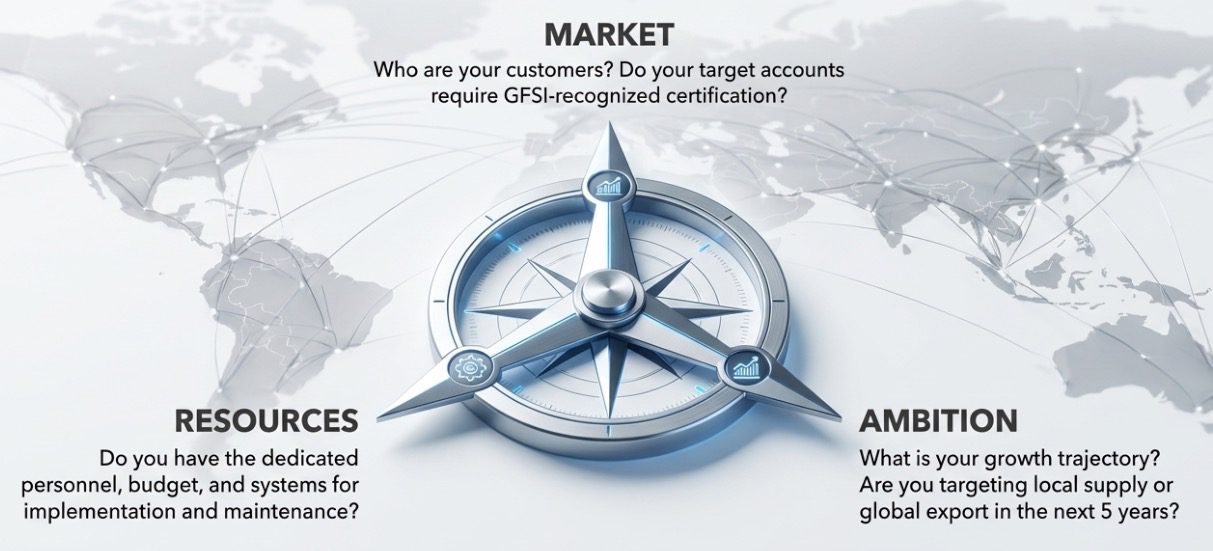
The decision about which certification to pursue isn’t purely technical—it’s strategic. Start by understanding your market requirements. If you’re supplying bubble tea ingredients to small independent shops, robust HACCP implementation might suffice. But if you’re targeting chains, retail channels, or export markets, ISO 22000 or FSSC 22000 becomes essential.
Customer requirements often make the decision for you. Many major food companies now require GFSI-recognized certification from their suppliers, which means FSSC 22000, SQF, BRC, or IFS. Check the specifications of your largest customers or target accounts. What certifications do they require? Are they asking for specific schemes or accepting any GFSI-recognized standard?
Resource availability matters significantly. FSSC 22000 implementation requires dedicated quality management personnel, extensive documentation, and sophisticated monitoring systems. A small manufacturer with limited resources might struggle to maintain FSSC 22000 compliance, while ISO 22000 or strong HACCP could provide adequate food safety with more manageable resource requirements.
Consider your operational complexity. Simple operations with limited product lines and straightforward processes can implement HACCP effectively. As complexity increases—multiple product lines, custom formulations, various packaging formats, allergen management challenges—the management system approach of ISO 22000 or FSSC 22000 provides better control frameworks.
Think about your growth trajectory. If you’re planning significant expansion, international markets, or major customer acquisition, investing in FSSC 22000 now could prevent the need to upgrade certification later. The disruption of implementing a new certification system mid-growth can be substantial. Starting with the certification you’ll eventually need might cost more upfront but save long-term headaches.
Implementation Considerations and Timeline
Implementing any food safety management system requires careful planning and resource allocation. For HACCP, expect three to six months for a motivated team to conduct hazard analysis, establish control points, develop monitoring procedures, train staff, and validate the system. This assumes you already have basic prerequisite programs in place.
ISO 22000 implementation typically takes six to twelve months, with much of the additional time spent developing management system documentation—procedures, work instructions, forms, records systems. You’ll need to conduct internal audits, management reviews, and corrective action processes before you’re ready for certification audit. Many companies underestimate the documentation burden and find themselves scrambling to create required procedures during the final months.
FSSC 22000 implementation can take twelve to eighteen months or longer, particularly if you’re starting from scratch. The sector-specific prerequisite requirements often require facility modifications, enhanced monitoring systems, and more sophisticated analytical capabilities. Food fraud mitigation programs require supplier assessments and vulnerability analyses. Food defense requires security measures and personnel vetting. All of this takes time and money.
Regardless of which certification you pursue, certain implementation best practices apply. Start with management commitment—without visible leadership support, implementation efforts stall. Form a cross-functional team representing operations, quality, maintenance, and procurement. Get external expertise when needed; consultants who’ve guided multiple certifications can accelerate your timeline and avoid common pitfalls.
Training is non-negotiable. Everyone from production floor staff to executive management needs to understand food safety principles and their role in the system. According to food safety research from Cornell, facilities with comprehensive training programs achieve certification faster and maintain better ongoing compliance than those treating training as a checkbox exercise.
The Economics of Certification
Certification costs vary widely based on facility size, product complexity, and current state of food safety programs. Initial HACCP implementation might cost $5,000-$15,000 for a small facility working with consultants. ISO 22000 certification typically runs $15,000-$40,000 for initial implementation and certification audit. FSSC 22000 can cost $30,000-$75,000 or more for comprehensive implementation in medium to large facilities.
But these upfront costs tell only part of the story. Annual maintenance involves surveillance audits ($3,000-$8,000 depending on scheme and facility size), internal audit programs, management system reviews, and continuous improvement activities. Some companies designate full-time food safety coordinators or quality managers to maintain certification, adding significant personnel costs.
The return on investment comes through market access, operational improvements, and risk mitigation. Research from McKinsey on food safety systems quantifies benefits including 20-30% reduction in product recalls, 15-25% decrease in customer complaints, improved supplier relationships, and premium pricing power in some market segments. For food ingredient manufacturers targeting quality-conscious customers, certification can be the difference between winning and losing major contracts.
Insurance premiums often decrease for certified facilities, though quantifying this benefit varies by insurer and coverage. More significantly, certification dramatically reduces the financial risk of recalls, legal liability, and brand damage from food safety incidents. One major recall can cost millions of dollars and permanently damage reputation—certification systems are insurance policies that pay dividends by preventing incidents rather than covering their costs.
Beyond Compliance: Certification as Continuous Improvement
The most successful companies view certification not as a compliance burden but as a continuous improvement framework. The management system approach required by ISO 22000 and FSSC 22000 creates formal mechanisms for identifying opportunities, implementing changes, measuring results, and driving ongoing enhancement of both food safety and operational efficiency.
Annual surveillance audits provide external perspective on system effectiveness. Auditors often identify opportunities for improvement that internal teams overlook due to operational familiarity. Smart companies treat audit findings not as failures but as free consulting advice about how to strengthen their systems.
The data generated by certified management systems—monitoring records, corrective actions, internal audit findings, customer feedback—creates opportunities for analytical insights. Facilities with strong data cultures use this information to identify trends, predict potential issues, and optimize processes. This transforms food safety systems from cost centers to value generators.
Integration with other management systems amplifies benefits. Companies combining ISO 22000 food safety with ISO 9001 quality management and ISO 14001 environmental management create synergies that reduce documentation burden while improving overall operational excellence. Many professional food manufacturers now operate integrated management systems that address multiple stakeholder requirements through coordinated approaches.
The Certification Audit Process
Understanding what auditors assess helps demystify certification. Audits typically begin with an opening meeting where auditors explain the process and review the scope. Documentation review follows—auditors examine your HACCP plan, management system procedures, monitoring records, corrective actions, and verification data. They’re looking for evidence that your system meets standard requirements and that you’re actually implementing what you’ve documented.
The facility tour and process observations form the audit core. Auditors walk your production areas observing actual practices, interviewing employees about their understanding of food safety procedures, and verifying that monitoring equipment is properly calibrated and maintained. They’ll check that cleaning is performed as documented, that temperature controls are functioning, that allergen management protocols are followed.
Employee interviews can make or break certification success. If your documented procedures are perfect but line operators can’t explain their role in food safety or don’t follow written instructions, certification will be withheld. This underscores why training and food safety culture are as important as documentation.
Nonconformities identified during audits are classified by severity. Minor nonconformities are issues that don’t immediately threaten food safety but represent system gaps. Major nonconformities are serious issues that could affect food safety or represent fundamental system failures. Major nonconformities typically require correction before certification is granted, while minor nonconformities must be addressed within a specified timeframe.
Future Trends in Food Safety Certification
The food safety certification landscape continues evolving. Increasing emphasis on food fraud prevention, climate resilience, and supply chain transparency is driving new requirements. The latest version of FSSC 22000 (version 6, released in 2023) added requirements for mycotoxin management, food culture assessment, and enhanced social compliance elements.
Technology integration is transforming how certification systems operate. Digital record-keeping, automated monitoring systems, blockchain-based traceability, and AI-powered quality analytics are becoming standard expectations. Future certification schemes will likely require technological sophistication that smaller operators may struggle to implement without external support.
Remote auditing, accelerated during COVID-19, is becoming a permanent option for certain audit types. While initial certification audits still require on-site presence, surveillance audits may increasingly utilize video technology, digital record review, and remote interviews. This could reduce certification costs and make audits less disruptive to operations.
Harmonization between schemes continues, with GFSI working to align requirements across recognized certification programs. The goal is reducing the burden on manufacturers supplying multiple markets by creating greater equivalency between schemes. However, complete harmonization remains unlikely given different regional regulatory frameworks and customer expectations.

FAQ
HACCP is the foundational food safety hazard control system focusing on critical control points. ISO 22000 integrates HACCP into a complete management system framework covering all organizational operations. FSSC 22000 builds on ISO 22000 by adding sector-specific prerequisite programs and additional requirements, creating the most comprehensive certification scheme with GFSI recognition. They represent progressive sophistication levels, not alternatives.
FSSC 22000 is ideal for export markets. It’s GFSI-recognized, which many international retailers and food manufacturers require from suppliers. Other GFSI schemes include SQF, BRC, and IFS, but FSSC 22000 has gained particular traction in ingredient manufacturing. This certification effectively opens doors to global supply chains and demonstrates compliance with internationally recognized best practices across all food safety aspects.
Initial costs vary by facility size and complexity. HACCP implementation costs $5,000-$15,000, ISO 22000 runs $15,000-$40,000, and FSSC 22000 ranges from $30,000-$75,000 or more. Annual maintenance includes surveillance audits ($3,000-$8,000), internal audits, and continuous improvement activities. While substantial, benefits include market access, operational improvements, 20-30% reduction in recalls, and reduced insurance premiums.
HACCP implementation typically takes 3-6 months, ISO 22000 requires 6-12 months, and FSSC 22000 needs 12-18 months or longer. Time differences reflect documentation requirements and system complexity. FSSC 22000 may require facility modifications, enhanced monitoring systems, and sophisticated analytical capabilities. Starting from scratch with comprehensive staff training and system validation can extend timelines further.
Small operations should start with HACCP. It focuses on hazard control with moderate documentation and lower resource requirements. If customer requirements increase or market expansion is planned, upgrade to ISO 22000. FSSC 22000, while most comprehensive, requires dedicated quality personnel and extensive documentation, making it better suited for medium-to-large facilities or those targeting international markets. Consider customer requirements, resource availability, and growth trajectory.
Sources & References
- FDA – Hazard Analysis Critical Control Point (HACCP) — Official HACCP guidance and principles
- ISO – ISO 22000 Food Safety Management — International food safety standard
- FSSC 22000 Foundation — Comprehensive certification scheme details
- Global Food Safety Initiative (GFSI) — Benchmarking and scheme recognition
- Cornell Food Science Department — Food safety system research and best practices
- McKinsey – Food Safety & Quality — ROI analysis for food safety investments
About the Author
Dr. Katherine Lin is a Quality Systems Manager at YenChuan, specializing in food safety management system implementation and certification. With 15 years of experience in food safety auditing and quality management, she has guided over 40 facilities through successful HACCP, ISO 22000, and FSSC 22000 certification. Dr. Lin holds a Ph.D. in Food Science from UC Davis and previously worked as a lead auditor for a GFSI-recognized certification body. She believes that the best food safety systems aren’t the ones with the most documentation—they’re the ones embedded so deeply in organizational culture that everyone from the CEO to the sanitation crew sees food safety as their personal responsibility.
Connect with the YenChuan team on LinkedIn.
Ready to Strengthen Your Food Safety Systems?
Whether you’re pursuing your first HACCP implementation or upgrading to FSSC 22000 certification, having the right partner makes the journey significantly smoother. YenChuan maintains FSSC 22000 certification at our Taiwan manufacturing facility, with comprehensive food safety management systems that have withstood audits from major international customers and certification bodies for over three decades.
Our experience implementing and maintaining these systems informs everything we do—from ingredient development to production controls to supply chain management. When you work with certified suppliers, you’re not just buying ingredients; you’re partnering with organizations that understand the food safety commitments your business depends on.
Let’s discuss how our certified operations can support your food safety objectives. Book a consultation with our team →